
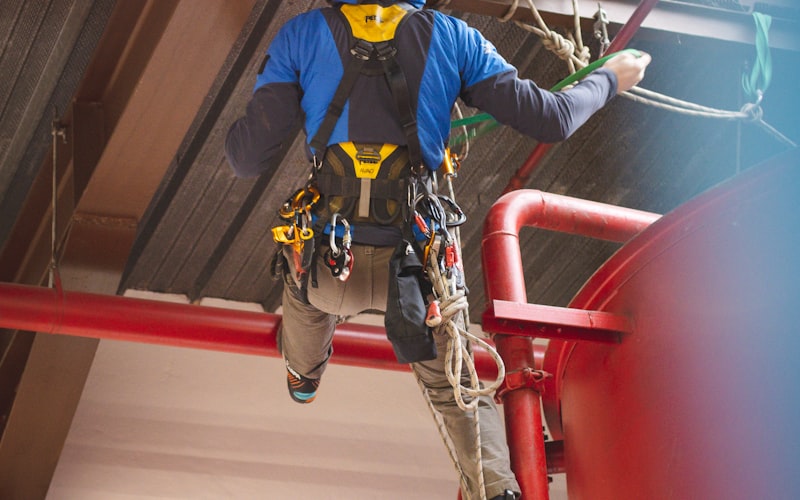
Fall protection violations are the single most cited OSHA standard in the construction industry, and roofers account for a disproportionate share of those citations. Despite this, most roofing contractors have only a vague understanding of what 29 CFR 1926.501 actually requires. The standard is more nuanced than "harness up at six feet" — and the exceptions, requirements, and enforcement triggers matter enormously for both your OSHA compliance and your workers' compensation costs.
The 6-Foot Rule and When It Applies
The fundamental trigger for fall protection in construction is 6 feet. Under 1926.501(b)(1), each employee on a walking/working surface with an unprotected side or edge that is 6 feet or more above a lower level must be protected by a guardrail system, safety net system, or personal fall arrest system.
This is a construction standard — general industry (1926 vs 1910) has different thresholds. For roofers, we're always in construction, so 6 feet is the relevant number. Practically, this means:
- Any roof edge where the ground is 6+ feet below requires protection
- Holes in roofing surfaces (skylights, vent openings) require covers or guardrails
- Leading edges during new construction require fall protection
- The 6-foot measurement is from the walking/working surface to the level below — not from the eave
There's no exception for "just doing an inspection" or "only up there for five minutes." The duration of exposure doesn't change the requirement. If an employee is exposed to a 6-foot or greater fall hazard for even a moment, protection is required.
Residential Roofing Exceptions Under 1926.501(b)(13)
This is where most confusion — and most citations — occur. Section 1926.501(b)(13) provides an alternative for residential construction, but it doesn't say what most roofers think it says.
The standard states that each employee engaged in residential construction activities 6 feet or more above lower levels shall be protected by guardrail systems, safety net systems, or personal fall arrest systems unless the employer can demonstrate that it is infeasible or creates a greater hazard to use these systems. In that case, the employer must develop and implement a fall protection plan that meets the requirements of 1926.502(k).
Key requirements of this exception:
- It only applies to residential construction — defined as construction, alteration, or repair of single-family homes and townhouses not exceeding 4 stories
- The employer must demonstrate infeasibility — this is an affirmative defense, meaning you need documentation explaining why conventional fall protection cannot be used
- A written fall protection plan is required — not optional. The plan must be site-specific and prepared by a qualified person
- Alternative measures must be used — slide guards, toe boards, safety monitors, or other measures appropriate to the situation
The most common mistake residential roofers make is believing this exception eliminates all fall protection requirements. It doesn't. It allows alternative measures when conventional systems are infeasible — but you still need a written plan, trained employees, and documented alternative measures in place.
Low-Slope vs Steep-Slope Requirements
OSHA distinguishes between low-slope roofs (4:12 pitch or less) and steep-slope roofs (greater than 4:12). The available protection methods differ:
Low-slope roofs (≤ 4:12):
- Guardrail systems
- Safety net systems
- Personal fall arrest systems
- Warning line systems (combined with other methods on roofs 50 feet or less in width)
- Safety monitoring systems (only on roofs 50 feet or less, combined with warning lines)
Steep-slope roofs (> 4:12):
- Guardrail systems with toeboards
- Safety net systems
- Personal fall arrest systems
Warning line systems and safety monitors are not permitted as fall protection methods on steep-slope roofs. This catches many commercial roofers off guard — if you're working on a steep-slope commercial roof, your only options are guardrails, nets, or personal fall arrest (harness and lanyard).
For low-slope commercial roofing, the warning line/safety monitor combination is common but has specific requirements: the warning line must be erected not less than 6 feet from the roof edge, must be flagged at 6-foot intervals, and must have a tensile strength of 500 pounds. A safety monitor must be a competent person who can recognize fall hazards and has the authority to warn workers.
What Triggers an OSHA Inspection for Roofers
OSHA doesn't randomly inspect roofing jobsites — there are specific triggers that bring an inspector to your project:
Imminent danger: If an OSHA inspector or compliance officer observes workers on a roof without visible fall protection while driving by, they can initiate an inspection. Roofing is highly visible work, and compliance officers in vehicles constitute a significant portion of roofing inspections.
Employee complaints: Any employee can file a confidential complaint with OSHA. Disgruntled former employees or current workers who feel unsafe are common sources. OSHA is required to investigate formal complaints.
Fatality or hospitalization: Employers must report any workplace fatality within 8 hours and any amputation, loss of an eye, or in-patient hospitalization within 24 hours. A fall from a roof that results in hospitalization triggers an automatic investigation.
Referrals: Other government agencies, general contractors, and even homeowners can refer situations to OSHA. Building inspectors who observe fall protection violations during their inspections frequently make referrals.
Programmed inspections: OSHA maintains a Site-Specific Targeting program that focuses on industries with high injury rates. Roofing (NAICS 238160) is consistently on this list, meaning OSHA allocates inspection resources specifically to roofing contractors.
The practical reality: if your crews are on roofs without visible fall protection in any urban or suburban area, it's a matter of when — not if — you'll be inspected.
OSHA Citations and How They Affect Your Insurance
OSHA citations come in several categories, and the insurance implications vary dramatically:
Other-Than-Serious: Violations that have a direct relationship to safety but probably would not cause death or serious physical harm. Penalties up to $16,131 per violation (2026 adjusted). Minimal insurance impact if corrected promptly.
Serious: Violations where there is substantial probability that death or serious harm could result and the employer knew or should have known of the hazard. Penalties up to $16,131 per violation. These show up on your OSHA record and underwriters will see them.
Willful: Violations where the employer intentionally and knowingly committed the violation or showed plain indifference to the law. Penalties from $11,524 to $161,323 per violation. These are insurance program killers — many carriers will non-renew immediately upon learning of a willful citation.
Repeat: Violations of the same or similar standard within 5 years. Penalties up to $161,323 per violation. Like willful violations, these signal systemic non-compliance that carriers won't tolerate.
The insurance impact cascades beyond just the citation:
- Workers' comp EMR: If the citation relates to a claim (which it usually does — a fall caused the inspection), the underlying claim drives your experience modification rate up significantly. A serious fall claim can push your EMR above 1.5 for three years.
- GL underwriting: At renewal, your GL carrier will check your OSHA history. Serious or willful citations related to fall protection suggest systemic safety failures that increase completed operations exposure.
- Umbrella/excess placement: Excess carriers are particularly sensitive to OSHA citations. A willful fall protection citation may make excess coverage unavailable at any price.
Building a Compliant Fall Protection Program
A compliant fall protection program isn't just about buying harnesses — it requires written documentation, training, equipment inspection, and consistent enforcement. Here's what OSHA expects:
Written Fall Protection Plan: Required under 1926.502(k) and whenever the residential exception is invoked. Must include identification of fall hazards, method of fall protection for each hazard, procedures for assembly/disassembly of protection systems, and rescue procedures for fallen workers.
Competent Person: OSHA requires a competent person on each jobsite who can identify existing and predictable fall hazards, has authorization to take corrective measures, and has been trained in fall protection systems. This isn't a certification — it's a demonstrated capability that should be documented.
Training Requirements: Under 1926.503, each employee exposed to fall hazards must be trained by a competent person in: the nature of fall hazards, correct procedures for erecting/maintaining/disassembling fall protection systems, use and operation of all systems used, and the role of each employee in the safety monitoring system. Training must be documented and repeated when there are changes or when employees demonstrate inadequate understanding.
Equipment Inspection: All fall protection equipment must be inspected before each use. Harnesses, lanyards, anchors, and self-retracting lifelines have specific inspection criteria. Any equipment subjected to impact loading (an actual fall) must be immediately removed from service.
Rescue Planning: This is frequently overlooked. OSHA requires that employers provide for prompt rescue of employees in the event of a fall. "Call 911" is not an adequate rescue plan — suspension trauma can be fatal within minutes, and most fire departments are not equipped for rope rescue from commercial roof heights.
Documentation that helps your insurance program:
- Signed training records with dates and topics covered
- Daily jobsite safety briefing logs
- Equipment inspection records
- Competent person designations
- Site-specific fall protection plans for each project
- Disciplinary records showing enforcement of safety rules
Compliance with 1926.501 isn't just about avoiding $16,000 fines — it's about keeping your workers alive and your insurance costs manageable. A single serious fall drives your workers' comp EMR up for three years, raises questions at every GL renewal, and can make umbrella coverage unavailable. The cost of a compliant fall protection program — training, equipment, supervision — is a fraction of what one fall claim does to your insurance program over 36 months. Build the program, document everything, and enforce it consistently.