
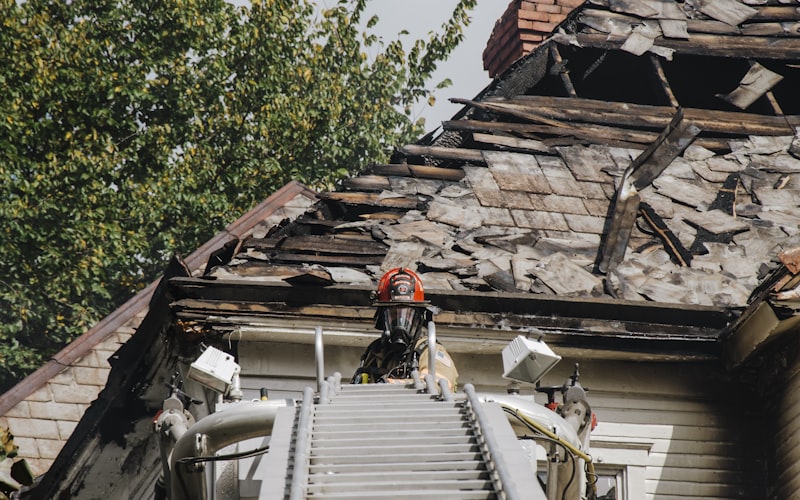
A single hot work fire claim can take a roofing contractor from a preferred insurance program with competitive rates to an E&S market placement at triple the premium — or worse, uninsurable in any market. No other claim type in roofing triggers carrier reaction as severe or as fast as a fire caused by a torch, kettle, or hot-applied material. Here's why, what happens after, and how to prevent it.
What Happens to Your Policy After a Fire Claim
The timeline after a hot work fire claim typically unfolds like this:
Day 1-3: You report the claim. The carrier assigns an adjuster and begins coverage investigation. For significant fires ($100,000+), a special investigations unit (SIU) referral is common — not because they suspect fraud, but because fire claims require detailed cause-and-origin analysis.
Day 3-30: The adjuster and cause-and-origin expert inspect the damaged property. If the fire started from your roofing operations (torch, kettle, hot mop), the claim is confirmed as a hot work fire. Your carrier's underwriting department is notified.
Day 30-60: Depending on your policy period, one of two things happens:
- Non-renewal: If you're more than 60 days from renewal, the carrier issues a non-renewal notice effective at your policy expiration. You'll get 30-60 days notice depending on state law.
- Mid-term cancellation: In severe cases (multiple fires, safety violations, large losses), some carriers will cancel mid-term. Texas requires 10 days notice for non-payment cancellation and 30 days for underwriting cancellation.
Day 60+: The claim develops. Building damage, business interruption claims from the property owner, additional living expenses if residential — total incurred values climb rapidly. A fire that starts with torch work on a commercial roof can easily generate $500,000 to $5,000,000 in total damages.
Your carrier will defend you and pay the claim (assuming no coverage exclusions apply), but they will not renew your policy. You are now shopping for new insurance with an open fire claim on your loss runs.
Why Carriers React So Aggressively to Hot Work Fires
Not all claims trigger non-renewal. A $50,000 water intrusion claim might get a conversation. A $30,000 auto accident might get a surcharge. But a hot work fire — even a small one — frequently means immediate non-renewal. Why?
Severity potential: Fire claims have essentially unlimited severity. A torch that ignites insulation in a wall cavity can burn an entire building. A commercial roof fire can spread to the building interior and destroy millions in inventory, equipment, and structure. Unlike a slip-and-fall or a water leak, fire has no natural ceiling on damages.
Third-party property damage: Hot work fires almost always damage someone else's property — the building you're working on. This means large property damage claims against your GL policy, often involving business interruption, displacement costs, and consequential damages that dwarf the physical repair cost.
Pattern behavior: Carriers know from actuarial data that contractors who have one hot work fire are statistically far more likely to have another. A fire claim indicates systemic issues with hot work procedures, fire watch compliance, or crew supervision — problems that don't resolve overnight.
Subrogation exposure: The building owner's property insurer will pay the building claim and then subrogate against your GL policy. This means your carrier is defending against a sophisticated insurance company's legal team, not just an individual claimant.
Loss ratio destruction: A $1,000,000 fire claim on a policy with $50,000 in premium creates a 2000% loss ratio. No underwriting portfolio can absorb that, and no rating adjustment makes the account viable going forward.
The Placement Problem After Non-Renewal
Once you've been non-renewed for a fire claim, finding new general liability coverage becomes a serious challenge:
Standard/admitted carriers: Will not quote you. Period. A hot work fire non-renewal within the past 3 years is an automatic declination in virtually every standard market's underwriting guidelines.
E&S (Excess and Surplus) carriers: This is where you'll end up. The surplus lines market exists for risks the standard market won't write. Expect:
- Premium increases of 200-400% over your prior program
- Higher deductibles ($5,000-$25,000 per occurrence vs $1,000-$2,500 previously)
- Hot work exclusions or limitations (some E&S carriers will exclude torch/kettle operations entirely)
- Annual policies only — no multi-year rate guarantees
- Mandatory safety requirements (written hot work programs, fire watch documentation, training certifications)
If you also do commercial/BUR work: The placement is even harder. Carriers that might write a residential shingle contractor with a fire claim often won't touch a commercial torch-down contractor with the same claim history.
Umbrella/excess coverage: May become unavailable at any price. Excess carriers are even more selective than primary carriers, and a fire claim can leave you without any coverage above your $1M/$2M primary limits.
How to Prevent the Claim in the First Place
Prevention isn't just about safety — it's about documenting prevention so that if a fire does occur, you can demonstrate it was an isolated incident rather than a systemic failure.
Written Hot Work Program: Every commercial roofer using open-flame equipment needs a written hot work program that includes:
- Permit system — a physical permit signed before any torch/kettle work begins
- Pre-work inspection checklist (combustibles identified and removed/protected)
- Fire extinguisher requirements (type, size, quantity, placement)
- Fire watch during operations and minimum 60 minutes after work ceases
- Designated fire watch personnel with documented training
Fire Watch Compliance: The #1 failure point. Most hot work fires start after crews leave for the day. Heat travels through roof assemblies and ignites insulation or decking hours after torch work ends. A 60-minute fire watch minimum is industry standard, but NFPA 241 recommends monitoring for up to 4 hours after cessation of hot work in some conditions.
Alternative Methods: Where possible, eliminate hot work entirely. Cold-applied adhesives, mechanically fastened systems, and self-adhered membranes remove the fire hazard completely. TPO contractors who use hot-air welding rather than torch-applied systems often qualify for better rates. More carriers are offering premium credits for contractors who commit to eliminating open-flame work.
Training and Documentation: Train every crew member on fire prevention, document the training, and retain records. Certifications like CERTA (Certified Roofing Torch Applicator) demonstrate competence and give underwriters confidence in your operation.
Rebuilding Your Insurance Program After a Fire Claim
If you've already had a fire claim, here's the realistic timeline for recovery:
Year 1 (claim year): You're in the E&S market paying 2-4x your prior premium. Focus on implementing a documented hot work program, obtaining certifications, and building a paper trail of safety compliance. Accept the premium hit — you have no leverage.
Year 2: If no additional claims occur and you can demonstrate a robust safety program, some E&S carriers will begin moderating your rate. Expect a 10-20% reduction, but you're still paying significantly more than pre-claim.
Year 3: The fire claim starts aging off underwriting relevance (though it stays on your loss runs for 5 years). Some preferred E&S carriers will now compete for your business, and you may see rates approaching 150-175% of your pre-claim level.
Years 4-5: Standard market carriers begin considering you again, depending on claim severity and your safety record in the interim. If the claim was under $250,000 and fully closed, some admitted carriers will quote. If it was a large or open claim, you may stay in E&S longer.
The math on prevention vs. recovery is unambiguous: a comprehensive hot work safety program costs $5,000-$15,000 annually (training, equipment, supervision time, documentation). A fire claim costs $100,000-$500,000 in direct premium increases over 3-5 years, plus the incalculable cost of lost projects, damaged reputation, and operational disruption. Prevention isn't just the safer choice — it's the only choice that makes financial sense. Talk to your insurance agent about hot work requirements before your next renewal, not after your next fire.