
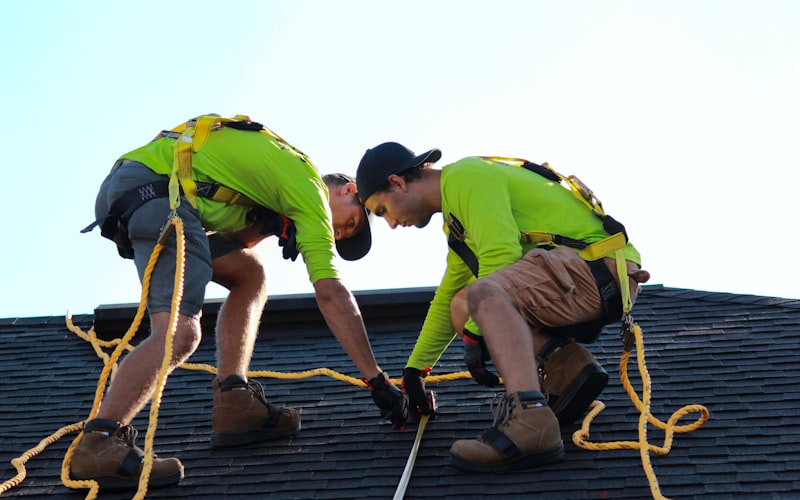
Class code 5551 is assigned to roofing contractors by the National Council on Compensation Insurance (NCCI) and most independent state rating bureaus. It's one of the highest-rated class codes in the entire workers' compensation system, and understanding how it works is essential to managing what is likely your largest single insurance expense. Here's what the code covers, how your premium is calculated, and what you can do about it.
What Class Code 5551 Covers
NCCI class code 5551 is titled "Roofing — All Kinds & Drivers." It applies to contractors whose primary work involves the application, repair, or replacement of roof coverings. The code captures:
- New roof installation (residential and commercial)
- Roof repair and maintenance
- Re-roofing and tear-off operations
- Hot-applied built-up roofing (BUR)
- Single-ply membrane installation (TPO, EPDM, PVC)
- Metal roofing installation
- Shingle installation (asphalt, wood, slate, tile)
- Roof coating application
- Drivers who deliver materials to jobsites (included in the code)
The code is comprehensive — it doesn't distinguish between steep-slope residential work and low-slope commercial membrane installation. Whether you're nailing three-tabs on a ranch house or welding TPO seams on a warehouse, your field employees fall under 5551.
Importantly, the code includes all work incidental to roofing operations. This means if your roofers also do gutter installation, fascia repair, or ventilation work as part of a roofing project, that payroll stays in 5551. It's only separately classifiable if it's performed by employees who do exclusively non-roofing work.
How the Rate Is Calculated
Your workers' comp premium for code 5551 follows this basic formula:
(Payroll ÷ 100) × Manual Rate × Experience Modification Rate = Premium
The manual rate for 5551 varies significantly by state. Some representative examples:
- Texas: Approximately $14-$18 per $100 of payroll (voluntary market)
- Florida: Approximately $12-$16 per $100 of payroll
- California: Approximately $25-$35 per $100 of payroll
- Colorado: Approximately $15-$20 per $100 of payroll
- Illinois: Approximately $20-$28 per $100 of payroll
To put this in perspective: a Texas roofing contractor with $500,000 in field payroll at a manual rate of $16 per $100 and a 1.0 EMR would pay approximately $80,000 annually just for workers' comp coverage on field employees. That's before any schedule credits or debits are applied.
Your Experience Modification Rate (EMR) is the multiplier that adjusts your premium based on your actual loss history compared to expected losses for your class code. An EMR of 1.0 means you're average. Below 1.0 means fewer/smaller claims than expected (you get a discount). Above 1.0 means more/larger claims than expected (you pay a surcharge).
For roofing contractors, even one serious claim can push your EMR well above 1.0. A $200,000 fall claim can increase your EMR by 0.3-0.5 points, adding tens of thousands in annual premium for three years.
Related Class Codes Roofers Use
Most roofing companies have employees who don't spend all their time on roofs. Understanding which class codes apply to non-roofing employees can significantly reduce your premium:
5552 — Roofing: Sheet Metal Work (Including Drivers): This code applies to sheet metal roofing operations, including standing seam metal roof installation. In some states, this carries a slightly different rate than 5551. Check with your agent whether your metal roofing crews can be separately classified.
8742 — Salespersons (Outside): Sales representatives who spend their time inspecting roofs, writing estimates, and selling jobs — but never perform physical roofing labor — may qualify for this code. Rates are typically $1-$3 per $100 of payroll. The key requirement: these employees must never pick up a nail gun or assist with installation.
8810 — Clerical Office Employees: Office staff who answer phones, process invoices, and perform administrative work qualify for this code at approximately $0.20-$0.50 per $100 of payroll. They must be separated from the shop/warehouse by a physical barrier and never visit jobsites.
7380 — Drivers/Chauffeurs (Not Otherwise Classified): In some states, dedicated delivery drivers who only transport materials and never work on roofs can be separately classified. This is narrowly applied and requires clear job descriptions.
8227 — Construction Project Manager: Supervisors who direct work but don't perform physical labor may qualify. However, this is aggressively audited — if your "project manager" ever helps carry a bundle of shingles up a ladder, the auditor will reclassify their entire payroll to 5551.
Splitting Payroll Across Codes
The rules for splitting payroll between class codes are strict and frequently misunderstood:
The Standard Exception Rule: Clerical (8810) and outside sales (8742) employees can always be separately classified, regardless of what the company does. But they must meet specific criteria — 8810 employees must work exclusively in a clerical environment separated from operations, and 8742 employees must exclusively perform outside sales activities.
The General Inclusion Rule: An employee who performs any roofing work during the policy period will have their entire payroll assigned to 5551, even if they spend most of their time doing estimating or project management. There is no "majority of time" test — any roofing exposure means 100% of that employee's payroll goes to 5551.
Exceptions for dual operations: If your company genuinely operates two separate divisions (for example, roofing and general carpentry), and employees are permanently assigned to one division, you may be able to split. But this requires separate crews, separate supervision, and clear documentation.
The practical takeaway: if you want to keep certain employees out of 5551, they can never touch roofing work. Not even once. Not "just to help out." One day on a roof during the policy period, and the auditor assigns their full year's salary to 5551.
How 5551 Compares to Other Contractor Codes
Roofing contractors pay more for workers' comp than almost any other trade. Here's why, with comparative rates (approximate, state-dependent):
- 5551 Roofing: $14-$35 per $100 of payroll
- 5190 Electrical (interior wiring): $4-$8 per $100
- 5183 Plumbing: $3-$7 per $100
- 5437 Carpentry (residential): $8-$15 per $100
- 5022 Masonry: $6-$12 per $100
- 5213 Concrete work: $5-$10 per $100
The rate differential reflects the actuarial reality: roofers get hurt more often and more severely than most other trades. The combination of height exposure, heavy materials, repetitive physical labor, heat stress, and equipment hazards (nail guns, torches, saws) creates a frequency and severity profile that drives rates up.
Falls are the primary cost driver. A single fall from a roof can generate $200,000-$500,000 in medical costs plus permanent disability payments. The lost-time injury rate for roofing is roughly 3x the construction industry average.
Audit Issues With Class Code 5551
The annual premium audit is where class code problems surface. Common audit issues for roofing contractors:
Subcontractor without coverage: If you use subcontractors who don't carry their own workers' comp policy, the auditor will include their payments as your payroll at the 5551 rate. A $100,000 sub payment without a certificate on file becomes $14,000-$35,000 in additional premium at audit.
Misclassified employees: Owners who classified themselves as 8742 (outside sales) but were seen on jobsites. Project managers coded at 8227 who assisted with physical work. The auditor will reclassify and back-bill.
Cash payments: Auditors look for discrepancies between 1099s, bank statements, and reported payroll. Unrecorded cash payments to workers are added back as uninsured payroll.
Overtime calculation: Workers' comp premium is calculated on straight-time payroll only. The overtime premium (the extra half) is excluded. Make sure your payroll records clearly distinguish overtime premium from regular pay — otherwise the auditor may include it all.
Tips for a clean audit:
- Collect certificates of insurance from every subcontractor before they start work
- Keep clear job descriptions documenting who does and doesn't perform roofing labor
- Maintain separate payroll records for each class code
- Document overtime hours clearly
- Review your payroll estimates at mid-term and adjust if necessary to avoid a large audit surprise
Managing your 5551 exposure comes down to three things: keeping claims down (which lowers your EMR), correctly classifying every employee (which ensures you're not overpaying), and maintaining subcontractor certificates (which prevents audit surprises). Work with an agent who specializes in roofing contractor insurance — the difference between a well-managed 5551 program and a poorly managed one can be six figures annually.